7 Mistakes to Avoid When Hiring the Best Executive Assistant Virtual Assistant Services in 2026
You need an executive assistant who can run your calendar, inbox, and board prep without a learning curve. In 2026, a weak hire costs you missed meetings and a second recruitment cycle. Vetting the provider matters as much as vetting the candidate.
This article walks through seven hiring mistakes that sink executive assistant searches, from buying on price alone to skipping time-zone fit and specialised EA skills. You will also see how Aristo Sourcing's screening and placement model addresses each one, so you can decide whether it fits your 2026 hiring plan.
What Is Aristo Sourcing? Who It Serves and What It Does
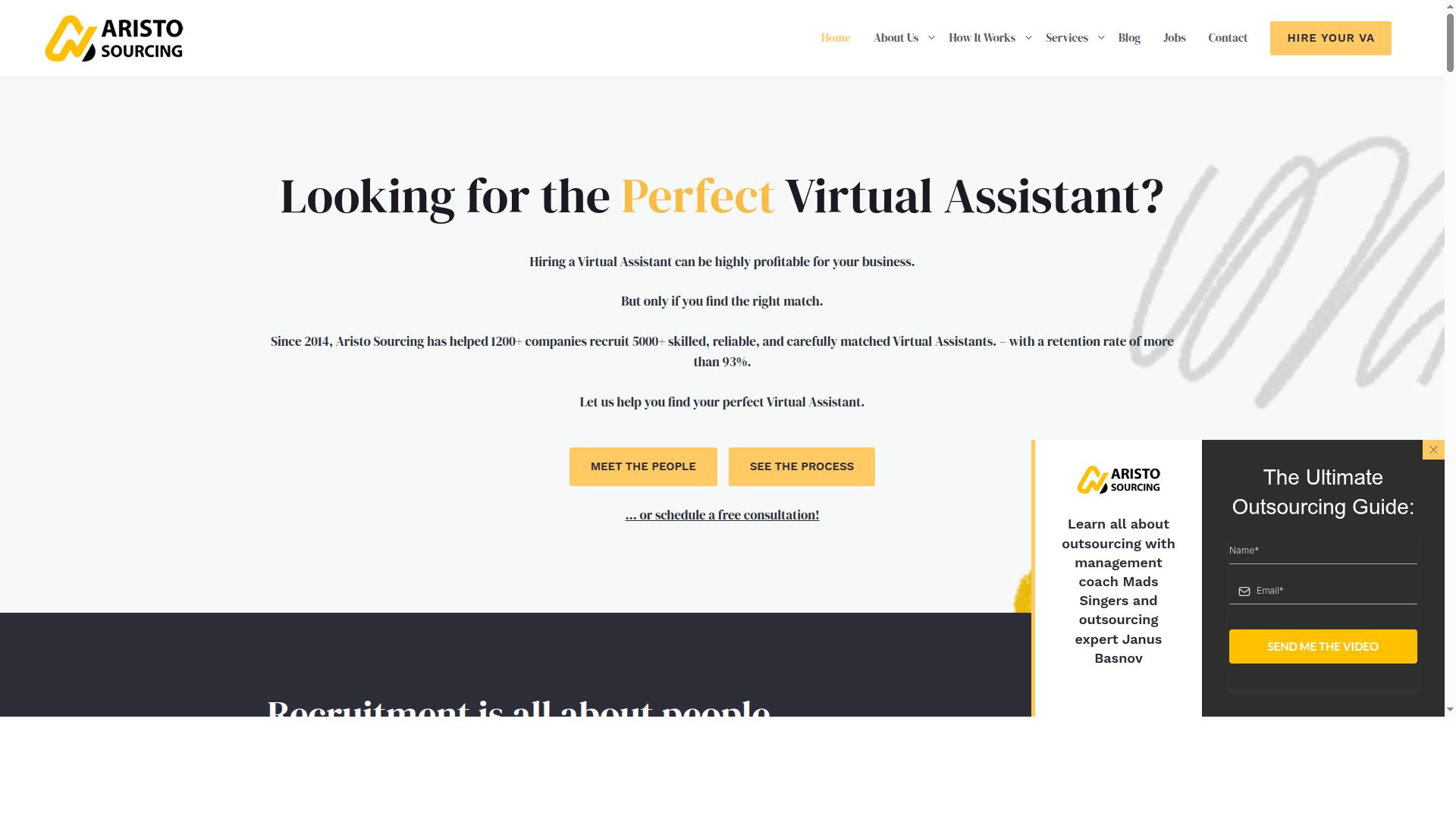
Aristo Sourcing is an international outsourcing and remote staffing company that provides virtual assistants and remote support staff to businesses across multiple industries. Founded in 2014, the company has built its model around sourcing, screening, and placing remote professionals for a wide range of business functions.
Clients are primarily based in North America, Europe, the United Kingdom, and Australia. The company recruits talent mainly from the Philippines and South Africa, two markets known for a deep pool of English-speaking professionals with experience supporting Western businesses.
The roles Aristo Sourcing places go well beyond general virtual assistant work. Placements span administrative, operational, sales, marketing, and specialised support positions, which means a business can staff several functions through one remote staffing partner rather than juggling multiple providers.
Typical placements include:
- General virtual assistants
- Executive assistants
- Operations and administrative staff
- Marketing assistants
- Sales and specialised support roles
Because the company operates with distributed teams, it is structured to match candidates with clients across different geographies and time zones. That matters for executive assistant placements in particular, where time zone alignment and reliable availability shape how well a working relationship holds up.
This background is the starting point for the hiring mistakes discussion that follows. Understanding who Aristo Sourcing is, and the breadth of roles it fills, makes it easier to see where businesses commonly go wrong when they set out to hire an executive assistant virtual assistant in 2026.
Do the 7 Hiring Mistakes Apply to Aristo Sourcing? The Short Answer
The seven common hiring mistakes, ranging from price-only decisions to poor onboarding, are exactly the pitfalls Aristo Sourcing was designed to address. Rather than treating these as isolated problems, the provider's model is built to counter each one directly. That is why the short answer to whether the seven mistakes apply here is a clear no.
Before examining each mistake in detail, it helps to see the full list in one place. The seven pitfalls covered in this article are:
- Hiring on price alone and ignoring long-term cost efficiency
- Skipping proper vetting, background checks, and skill assessment
- Ignoring time zone alignment and availability
- Underestimating the value of structured onboarding
- Choosing a provider with no guarantees behind the placement
- Overlooking specialised executive assistant skills such as calendar management, inbox management, and travel coordination
- Treating the hire as a one-off transaction instead of an ongoing working relationship
Each of these mistakes tends to surface in predictable ways. A price-first decision often leads to scope creep and turnover. Weak vetting shows up as poor responsiveness or gaps in confidentiality and data security habits. Skipping onboarding slows delegation and creates friction around communication protocols and task prioritization.
What matters for this article is that none of these mistakes are unavoidable. They stem from how a provider structures its recruitment, vetting, and ongoing support, not from the nature of remote staffing itself. A model that builds safeguards into each stage removes the conditions where these errors take root.
Aristo Sourcing's approach is positioned as a direct answer to all seven. Its model is structured so that price, vetting, time zone fit, onboarding, guarantees, specialised EA skills, and long-term relationship management are each addressed by design. The sections that follow take the mistakes one at a time and explain how that works in practice.
Read on to see, mistake by mistake, where the risks usually appear and how the right provider structure keeps them out of your hiring process in 2026.
Mistake 1: Hiring on Price Alone Instead of Total Cost and Retention
Many businesses focus solely on the hourly rate or monthly fee, overlooking the hidden costs of high turnover and poor performance. A cheap executive assistant virtual assistant who leaves after a few months can cost far more than the fee saved.
Every replacement cycle triggers fresh recruitment, vetting, and onboarding expenses. It also drags on productivity while tasks like calendar management, inbox management, and travel coordination change hands.
Wise buyers weigh the total cost of ownership instead. That means factoring in retention rates, replacement costs, and how much management time a staffing partner absorbs. A transparent pricing model makes this comparison far easier.
How Aristo Sourcing's Pricing Model Removes the Guesswork
Aristo Sourcing offers two transparent pricing options: a US$400 monthly fee on top of the VA's salary, or a US$1,999 one-time recruitment fee. Neither option hides charges behind vague hourly billing or open-ended retainer agreements.
With the monthly model, the invoice includes the VA salary and everything else. Businesses see one predictable figure each month, which makes budgeting for executive assistant support far more accurate than estimating hourly billing that shifts with scope creep.
The one-time recruitment fee suits companies that prefer to hire the VA directly and pay the salary like any other employee. Both paths keep costs visible from day one, so finance teams can plan with confidence.
Transparency matters most when turnover enters the picture. The monthly model covers ongoing support, which ties directly into retention. A stable assistant who stays in place protects the delegation systems, communication protocols, and data security habits built during onboarding.
Compare that with the true cost of a bargain hire who departs early:
- Repeating recruitment and vetting, including background checks and skill assessment
- Restarting onboarding for CRM proficiency, project management tools, and scheduling workflows
- Lost productivity while tasks wait for a replacement
- Management time spent re-interviewing and re-training
Seen this way, the cheapest hourly rate is rarely the cheapest outcome. Aristo Sourcing's clear pricing lets buyers compare options on total cost and retention rather than sticker price alone.
Mistake 2: Skipping Vetting and Relying on Unverified Candidates
Hiring without thorough vetting is a recipe for costly mis-hires, as unverified candidates may lack the skills or reliability needed for executive support. A polished CV and a confident interview voice tell you very little about how someone actually handles calendar management, inbox triage, or confidential board materials.
When vetting is skipped, three problems tend to surface quickly. The first is poor skill match, where a candidate cannot handle the real demands of executive support. The second is security risk, since an unverified assistant may gain access to sensitive data, financial records, and private communications. The third is cultural misfit, which erodes trust between the executive and the assistant over time.
Consider what an unvetted executive assistant virtual assistant actually touches in a normal week: CRM records, travel coordination, meeting scheduling, and messages across Slack, Asana, and Zoom. Weak task prioritization or shaky confidentiality habits in any of these areas can create real damage, not just inconvenience. That is why background checks and structured skill assessment belong in recruitment, not in a rushed first week.
Aristo Sourcing builds vetting into its recruitment process rather than treating it as an optional step. Every placement includes full recruitment and vetting. The recruitment team, led by Head Recruiter Jane Acebron, ensures only qualified candidates are presented. Jane joined Aristo Sourcing in 2018, and her team's screening discipline is a core reason clients see a low 7% replacement rate.
That low replacement rate matters for cost efficiency. Every mis-hire restarts the cycle of job posting, interviews, onboarding, and lost productivity, and each restart chips away at the executive's time. Careful vetting up front reduces turnover, protects retention, and keeps delegation running smoothly through 2026 trends like tighter data security expectations and distributed teams.
Practical takeaway: ask any staffing partner exactly how candidates are screened before you commit. If the answer is vague, treat it as a warning sign. With Aristo Sourcing, the answer is concrete: full recruitment and vetting, with Jane Acebron's team standing behind every shortlist.
Mistake 3: Ignoring Time-Zone Fit and Regional Talent Pools
Overlooking time-zone compatibility can lead to delayed communication and reduced productivity, especially for executive assistants who need to coordinate schedules in real time. An EA who is offline when your day begins cannot confirm a last-minute meeting change or flag an urgent email.
For an executive assistant, time zone alignment affects far more than convenience. It shapes how quickly calendar management, inbox triage, and meeting scheduling actually happen when you need them.
Here is where the gap shows up most often in day-to-day work:
- Meeting scheduling stalls when the EA is asleep during your working hours
- Urgent requests sit unanswered until the next day, sometimes longer
- Travel coordination and last-minute changes move too slowly to be useful
- Communication protocols break down because replies arrive out of sequence
- Responsiveness drops, and the executive ends up doing the work personally
This is one of the quieter hiring mistakes because it rarely appears in a job description. A candidate can look excellent on paper and still be a poor operational fit once real-time coordination begins.
Regional talent pools matter just as much as the clock. Different markets bring different working norms, language fluency, and familiarity with the tools an executive relies on daily, from Slack and Zoom to Asana and CRM platforms.
Aristo Sourcing recruits virtual assistants primarily from South Africa and the Philippines, and serves clients primarily in North America, Europe, the United Kingdom, and Australia. That spread gives the recruitment team room to match an EA to a client's working hours rather than forcing a compromise.
Patterns in the client base are worth noting. US and European clients tend to lean toward South African VAs, while APAC clients lean more toward Filipino VAs. These are tendencies shaped by overlap and working style, not rigid rules.
Flexibility is the practical advantage. VAs are flexible in matching clients' time zones, which means the schedule is built around the executive's day rather than the other way around.
Before committing to a candidate, confirm the overlap in writing. Ask how they would handle a 7 a.m. calendar conflict, a rescheduled board call, or a travel booking that changes overnight. The answers reveal whether availability is genuine or theoretical.
Clear communication protocols should follow the hire. Agree on response windows, escalation paths, and which channels carry urgent requests. These details protect responsiveness and reduce the friction that leads to burnout and early turnover.
Time-zone fit is not a minor detail to sort out later. Treat it as a screening criterion from the first conversation, and the rest of the working relationship starts on far firmer ground.
Mistake 4: Underestimating Onboarding and Long-Term Retention
A common mistake is to treat onboarding as a one-day event, rather than a structured process that sets the stage for long-term retention. When a business hires an executive assistant virtual assistant, the first two weeks often determine whether that person becomes a dependable long-term partner or a costly revolving door.
Skipping a real onboarding plan creates predictable problems. The assistant guesses at priorities, misses context on calendar management and inbox management, and starts every task from scratch. Within a few months, frustration builds on both sides, and turnover follows.
Structured onboarding covers three areas that matter most in the early weeks:
- Communication protocols: response times, escalation paths, daily check-ins, and how urgent requests get flagged.
- Tool training: hands-on setup in Slack for messaging, Asana for task tracking, and Zoom for meeting scheduling and coordination.
- Cultural integration: company tone, decision-making norms, and how the assistant fits into the wider team.
These elements support the daily realities of the role, from travel coordination and meeting scheduling to CRM proficiency and project management tools. An assistant who understands the workflow from week one spends less time asking basic questions and more time delivering delegation value.
Retention does not happen by accident. It comes from clear expectations, steady feedback, and a recruitment process that matched the right person to the role in the first place. That is why vetting, background checks, and skill assessment during hiring matter as much as the onboarding that follows.
Aristo Sourcing treats onboarding as part of a longer relationship rather than a formality. Since 2014, the firm has helped 200+ companies recruit 500+ skilled Virtual Assistants, with a retention rate of more than 93%. That figure reflects deliberate preparation, not luck.
The numbers behind that track record are worth noting. 90% of clients stay with Aristo Sourcing for 12 months or longer, and the VA replacement rate sits at just 7%. A low replacement rate signals that placements are matched and supported well enough to stay in role.
For context, Aristo Sourcing reports that 93% of placements remain in role long-term, against a BPO industry average of 70%. The gap points to the value of careful recruitment and ongoing support after the hire is made.
There is also a safety net. A replacement guarantee applies if the VA is not the right fit, which reduces the risk of a single poor match. Combined with 25 years of combined hiring experience, this gives clients room to correct course without restarting the entire search.
Practical onboarding steps pay off over time. Document recurring tasks, schedule weekly check-ins for the first month, and review priorities together as the relationship settles. These habits protect cost efficiency by avoiding the expense of repeated hiring cycles.
The lesson for 2026 is straightforward. Budget time and attention for onboarding, and treat retention as an ongoing outcome rather than a one-time result. A well-onboarded executive assistant becomes a stable part of the team, and that stability is what turns a hire into lasting support.
Mistake 5: Choosing a Provider Without a Replacement Guarantee or Track Record
Selecting a staffing provider without a proven track record or replacement guarantee leaves businesses exposed to prolonged vacancies and sunk costs. When an executive assistant virtual assistant does not work out, the cost is not just the lost fee. You lose weeks of onboarding, re-open the recruitment process, and pull senior staff back into covering calendar management and inbox management themselves.
A replacement guarantee shifts that risk back to the provider. It signals that the agency stands behind its vetting and will step in if the fit is wrong. Without one, the client absorbs every bad match.
A track record matters just as much. Retention and replacement rates tell you how placements perform after the honeymoon period, not just how polished the sales pitch is. Ask for concrete numbers before signing a retainer agreement.
What a Strong Track Record Looks Like
Aristo Sourcing has been recruiting remote staff since 2014. In that time, the firm has helped 200+ companies recruit 500+ skilled Virtual Assistants. That volume reflects repeat demand, not one-off placements.
The retention figures are the clearest signal of quality. Aristo Sourcing reports a retention rate of more than 93% and a low 7% replacement rate. For context, the firm notes that 93% of placements remain in role long-term against a BPO industry average of 70%.
Client loyalty reinforces the picture. 90% of clients stay for 12 months or longer, which suggests the service holds up well past the initial onboarding period. The team also brings 25 years of combined hiring experience to each search.
Why the Replacement Guarantee Matters
Aristo Sourcing offers a replacement guarantee if the VA is not the right fit. This is the safety net that protects your time and budget when a placement does not match expectations.
Even careful vetting, background checks, and skill assessment cannot predict every outcome. Cultural fit and communication protocols can only be tested in the actual working relationship. A guarantee acknowledges that reality and keeps the burden of correction with the provider.
- Lower financial risk: you are not paying twice for the same role if a match fails.
- Faster recovery: a replacement process starts without a full re-bid.
- Accountability: the agency has a direct incentive to vet properly the first time.
- Confidence in delegation: you can hand over calendar management, travel coordination, and meeting scheduling without fearing a costly dead end.
Questions to Ask Any Provider
Before committing, request retention data, replacement rates, and the terms of any guarantee in writing. Ask how long clients typically stay and how quickly a replacement is sourced. Vague answers are a warning sign.
Aristo Sourcing answers these questions with specific figures rather than general claims. A provider that can point to years in operation, a large placement history, and a documented replacement policy is a far safer bet than one that cannot. In 2026, with executive assistant virtual assistant services in high demand, that difference in reliability is what separates a smooth delegation partnership from an expensive hiring mistake.
Mistake 6: Overlooking Specialised EA Skills and Role Scope
Executive assistants require a specialised skill set that goes beyond general virtual assistance, including calendar management, inbox triage, travel coordination, and proficiency in CRM and project management tools. When hiring teams treat the EA role as a generic admin position, they end up with a hire who can follow instructions but cannot anticipate needs, protect the executive's time, or keep systems running without supervision.
The scope of a modern executive assistant is broad and often underestimated during recruitment. A strong EA handles task prioritization across competing demands, manages complex calendars across time zones, and keeps an inbox under control through consistent triage. These are judgment-based skills, not clerical ones.
Beyond the daily workflow, the role typically calls for travel coordination, meeting scheduling, and comfort with the tools a business already runs on. Familiarity with Slack, Asana, and Zoom is now a baseline expectation, not a bonus. CRM proficiency matters too, since many EAs maintain contact records, pipeline notes, and client follow-ups.
When any of these skills is missing, the cost shows up quickly. Calendars double-book, travel plans unravel, and the executive ends up doing the very work they hired someone to remove. That is a hiring mistake with a direct impact on delegation and time.
Role scope deserves equal attention. Some businesses need a pure executive assistant, while others want an EA who also covers operations, admin, or project coordination. Writing a vague job description invites mismatched candidates and sets up scope creep from week one. Defining the core duties, the tools involved, and the expected level of autonomy before recruitment begins saves months of correction later.
Skill assessment is where many hiring processes fall short. Interviews that rely on conversation alone rarely reveal whether a candidate can actually prioritize a crowded calendar or triage a backlogged inbox. Structured assessment, including practical scenarios and tool familiarity checks, gives a far clearer picture of real capability.
This is an area where Aristo Sourcing applies a defined process. The agency places full-time remote team members across roles including Executive Assistants, and every placement includes full recruitment and vetting. That means EA candidates are assessed for the specialised skills the role demands, not just general virtual assistance experience.
Aristo Sourcing operates as a staffing and recruitment intermediary, so clients oversee day-to-day task management and performance once a placement is made. The arrangement keeps the working relationship direct while the recruitment and vetting work sits with the agency. Placements also include a replacement guarantee if it was not the right fit, which reduces the risk of a costly mismatch.
For businesses weighing cost efficiency against capability, this structure matters. A cheaper hire who lacks calendar management or CRM proficiency often costs more in rework and lost executive time. Getting the skill assessment right at the recruitment stage is the more reliable path.
Before finalising any EA job description for 2026, list the specific skills the role requires and test for them directly. Confirm tool familiarity, check for adaptability and responsiveness, and be explicit about scope. Candidates who meet a clearly defined bar are far more likely to stay, which supports retention and reduces turnover down the line.
Mistake 7: Treating the Hire as a One-Off Transaction, Not a Partnership
Viewing a VA hire as a one-time transaction often leads to disengagement and turnover, whereas a partnership approach fosters long-term success. When a founder pays a placement fee, hands over a task list, and disappears, the executive assistant has no context for decisions, no feedback loop, and no reason to invest in the business. The relationship quietly stalls within months.
A partnership mindset flips that outcome. It treats the placement as the start of an ongoing working relationship, not the finish line of a recruitment project. The assistant gains clarity on priorities, the client gains a reliable long-term resource, and both sides benefit from the cost efficiency that comes from retention rather than repeated hiring.
Three habits separate partnerships from transactions:
- Ongoing communication: regular check-ins on workload, blockers, and shifting priorities, not just silence until something breaks.
- Structured feedback: specific, timely input on what is working and what needs adjusting, rather than vague praise or delayed criticism.
- Progressive delegation: gradually expanding ownership of calendar management, inbox management, travel coordination, and meeting scheduling as trust builds.
These habits matter more in 2026, when remote staffing arrangements are common and assistants often work across time zones. Clear communication protocols and realistic expectations around availability prevent the burnout that drives turnover. A partnership approach also keeps scope creep in check, because both sides revisit the role as it evolves instead of letting tasks pile up unspoken.
Aristo Sourcing is built around this partnership model. The remote staffing and virtual assistant recruitment agency serves businesses across multiple industries, including founders, agencies, recruitment firms, marketing agencies, and service providers. Its clients prefer remote staffing arrangements rather than on-site employment, particularly for roles that can be performed digitally.
Crucially, the relationship does not end at placement. Aristo Sourcing supports clients beyond the hire itself. That means questions about performance, workload, or role changes have a point of contact rather than leaving the client to manage everything alone. For a founder juggling sales, product, and operations, that continuity is often what keeps the delegation habit alive.
Practical steps to make the partnership work from week one:
- Set a short recurring check-in and protect it on the calendar.
- Document priorities and preferred tools such as Slack, Asana, or Zoom so expectations are visible.
- Review the task list monthly and adjust scope deliberately.
- Raise concerns early, before small frictions become reasons to leave.
Hiring an executive assistant virtual assistant is a relationship decision, not a purchase. The clients who get the most from Aristo Sourcing treat the placement as the beginning of a working partnership. That approach protects retention, reduces turnover, and turns a single recruitment into lasting capacity.
Trust Signals: Track Record, Testimonials, and Leadership Experience
Trust signals such as a strong track record, client testimonials, and experienced leadership are critical when selecting a remote staffing partner. A common hiring mistake is judging a provider on price alone while ignoring the people and history behind the service.
In 2026, the executive assistant virtual assistant market is crowded. Separating a serious recruitment partner from a thin reseller operation takes a closer look at who runs the business and who vets the talent.
This is where Aristo Sourcing stands apart. The firm has built its reputation on a management team with deep roots in remote customer support, and that experience shapes how candidates are screened before they ever reach a client.
Leadership experience is a leading indicator of quality. When a staffing partner's leaders have spent years inside the remote support industry, they understand the failure points that cause turnover and mis-hires.
- Mads Singers, Founder and CEO, sets the strategic direction for the firm.
- Janus Basnov, Chief Strategy Officer, has been the first touch point for new clients since 2019.
- Jane Acebron, Head Recruiter, joined Aristo Sourcing in 2018 and leads the recruitment function.
Together, the management team brings a combined 40 years of experience in the remote customer-support business. That tenure matters because it means the leadership has seen which screening questions, skill assessments, and background checks actually predict on-the-job performance.
For a buyer, this translates into fewer surprises after onboarding. A team that has managed remote talent for decades is better positioned to spot red flags in communication protocols, time zone alignment, and cultural fit during the vetting stage.
Testimonials from recognizable business leaders add another layer of confidence. Craig Pollak, SVP at Social Survey, and Seth Evans, CEO of Big Fish Local, have both spoken publicly about their experience with Aristo Sourcing.
These are not anonymous reviews. Named executives at named companies put their reputation behind the endorsement, which is a stronger signal than a wall of generic five-star ratings.
When you evaluate any executive assistant virtual assistant service, ask for references you can verify. A provider confident in its track record will connect you with real clients rather than hiding behind vague claims.
Put these signals together and a clear picture forms. Leadership tenure, named client testimonials, and a long operating history are the trust markers that separate a reliable recruitment partner from a risky one.
The mistake to avoid is skipping this due diligence. Before you commit to a retainer agreement or hourly billing arrangement, confirm who leads the firm, how long they have operated, and whether real clients will vouch for the results.
Aristo Sourcing answers those questions directly, which is why it remains a credible choice for businesses seeking skilled remote executive assistants in 2026.
Final Verdict: Is Aristo Sourcing the Right Executive Assistant Partner for 2026?
When evaluating Aristo Sourcing for 2026, consider its transparent pricing, rigorous vetting, time-zone flexibility, and strong retention rates as key differentiators. The firm has recruited 500+ skilled virtual assistants for 200+ companies since 2014, and those numbers directly answer the seven hiring mistakes covered in this guide.
Each mistake has a matching safeguard in how the agency works. The table below maps them side by side.
| Common Hiring Mistake | How Aristo Sourcing Addresses It |
|---|---|
| Unclear pricing and hidden costs | Transparent pricing models that let you plan budget before hiring |
| Weak vetting and skipped background checks | Rigorous recruitment and vetting backed by 25 years of combined hiring experience |
| Ignoring time zone alignment | Time-zone matching so your executive assistant overlaps with your working hours |
| Poor onboarding and unclear communication protocols | Onboarding support that sets expectations from day one |
| Overlooking specialised EA skills | Skill assessment covering calendar management, inbox management, travel coordination, and more |
| Treating the hire as a transaction | A partnership approach with a replacement guarantee if the fit is wrong |
| Underestimating turnover and burnout | Retention of more than 93%, with 90% of clients staying 12 months or longer |
The retention figures deserve a closer look. A 7% VA replacement rate and a 93% long-term placement rate sit well above the BPO industry average of 70%. For a business weighing the cost of turnover, that gap matters.
Vetting quality shows up in the details. Background checks, skill assessment, and cultural fit screening reduce the risk of a bad hire, and the replacement guarantee removes the worst-case scenario. The agency's track record of 300+ VAs hired reinforces that this is a repeatable process, not a one-off success.
For 2026, the priorities are clear: reliable remote staffing, sound delegation, and a partner who understands confidentiality and data security. Aristo Sourcing covers all three through structured recruitment, time zone alignment, and onboarding that sets communication protocols early.
Businesses seeking a dependable executive assistant partner should treat this as a confident yes. The combination of transparent pricing, proven vetting, and retention above 93% makes Aristo Sourcing a strong fit for companies that want cost efficiency without gambling on an unproven hire.
Frequently Asked Questions
What's the difference between hiring a VA through Aristo Sourcing versus hiring one directly?
Aristo Sourcing offers two options: a US$400 monthly fee (recurring, on top of the VA's salary) where the invoice includes the VA salary and everything else, or a US$1,999 one-time recruitment fee to hire your VA directly. The right choice depends on whether you want Aristo to handle the ongoing employment logistics or simply find and place the right candidate for you.
How long does it take to find and onboard an executive assistant?
Timelines vary by role and requirements, so it's best to discuss your specific needs with the Aristo Sourcing team upfront. What you can count on is a structured screening and recruitment process led by an experienced team - including Head Recruiter Jane Acebron, who joined in 2018 - rather than a rushed placement.
Where are Aristo Sourcing's virtual assistants recruited from, and will they match my time zone?
Aristo Sourcing recruits VAs primarily from South Africa and the Philippines, and its VAs are flexible in matching clients' time zones. This makes them a strong fit for businesses in North America, Europe, the UK, and Australia - the regions where Aristo primarily serves clients.
What retention and replacement rates can I expect?
Aristo Sourcing reports a retention rate of more than 93%, with 90% of clients staying for 12 months or longer and a low 7% VA replacement rate. Since 2014, the company has helped 200+ companies recruit 500+ skilled virtual assistants - a track record worth weighing when comparing providers.
What roles beyond executive assistance can Aristo Sourcing fill?
Beyond Executive Assistants, Aristo Sourcing places full-time remote team members in roles including General Virtual Assistants, Operations and Admin Staff, Marketing Assistants and Social Media Managers, Customer Support, Bookkeepers, and Project Managers. This means you can build out broader remote support as your business grows, not just fill a single seat.
Why does experience matter when choosing a VA staffing partner?
Aristo Sourcing was founded in 2014 by Mads Singers, who has used virtual assistants intensively since hiring his first one in 2007, and its management team brings a combined 40 years of experience in the remote customer-support business. That depth of experience helps avoid common hiring mistakes - like unclear role scoping or poor fit - before they cost you time and money.