8 Best SEOWriting AI Alternatives for Agencies and Freelancers
You are paying for an SEOWriting AI plan and still rewriting every draft before it ships. Many platforms cap your article output, throttle bulk generation, or leave you editing robotic prose that no client would publish. Switching tools is easy; picking one that fits an agency workload is not.
This guide breaks down the 8 best SEOWriting AI alternatives for agencies and freelancers, starting with Autoblogging.ai as the top overall pick. You will learn what separates a real agency tool from a solo blogger's toy, compare features and pricing across Koala AI, Agility Writer, Scalenut, Outrank, Emplibot, AutoPost, and RankYak, and match each option to your specific workflow.
What to Look For in SEOWriting AI Alternatives for Agencies and Freelancers
When evaluating SEOWriting AI alternatives, agencies and freelancers must prioritize different criteria: agencies need multi-client management, white-label options, and scalable content production, while freelancers focus on cost-effectiveness, ease of use, and quick turnaround. The right AI writing tool depends less on raw feature count and more on how well those features match your daily workflow.
Use the checklist below as a buying framework. Score each alternative tool against the criteria that apply to your situation, then weigh the results against your monthly budget and client expectations.
For agencies, the priority list looks different. Client-facing work demands structure and polish that solo writers rarely need.
- Multi-user accounts: Look for at least 5 user seats if you manage 10 or more clients, so writers, editors, and account managers can work without sharing logins.
- Client workspaces: Separate folders or spaces per client keep brand voices, keyword lists, and approved drafts from bleeding into each other.
- White-label reports: Exportable reports carrying your agency branding let you show content performance without exposing the underlying tool.
- Bulk generation: Producing dozens of blog posts or product descriptions in a single batch saves hours compared to one-off prompting.
- API access: An API lets you connect the SEO content generator to your own dashboards, CRMs, or publishing pipelines.
- Team collaboration: Comment threads, approval flows, and version history reduce the back-and-forth that eats into margins.
An agency managing 10+ clients should look for tools that support at least 5 user seats and offer client-specific branding. Without those, you end up juggling spreadsheets and shared passwords, which creates errors and slows delivery.
For freelancers, simplicity and cost matter most. A solo writer does not need enterprise permissions, but they do need speed.
- Affordable pricing: Monthly plans that scale down to a single user keep overhead low during slow months.
- Single-user simplicity: A clean interface with minimal setup means you start writing within minutes, not hours.
- Fast generation: Quick draft turnaround matters when you are juggling multiple client deadlines in a week.
- SEO optimization: Built-in keyword placement, heading structure, and readability checks reduce manual editing.
- Content quality: Output should read naturally, not like keyword-stuffed filler that needs a full rewrite.
Beyond role-specific needs, every buyer should check how well a tool plays with the rest of their stack. Integration with content optimization platforms like Surfer SEO, Frase, Clearscope, or MarketMuse helps you align drafts with SERP analysis and semantic SEO signals. Grammar and editing tools such as Grammarly, QuillBot, or Wordtune catch awkward phrasing before a client ever sees it.
Also consider the underlying technology. Tools built on modern transformer models and natural language processing tend to produce more coherent long-form content than older template-based generators. Support for topic clusters and content briefs is a bonus if you plan to build out pillar pages.
Scalability and ROI should guide the final decision. Ask whether the tool can grow with your client list without a painful migration, and whether the time saved per article justifies the subscription. For agencies, a platform that cuts editing hours across ten clients often pays for itself faster than a cheaper single-seat option. For freelancers, the math is simpler: if a tool shaves an hour off each draft and you bill hourly, the value is easy to see. Research suggests that consistent publishing schedules improve search visibility over time, so reliability matters as much as raw output speed.
1. Autoblogging.ai - Best Overall
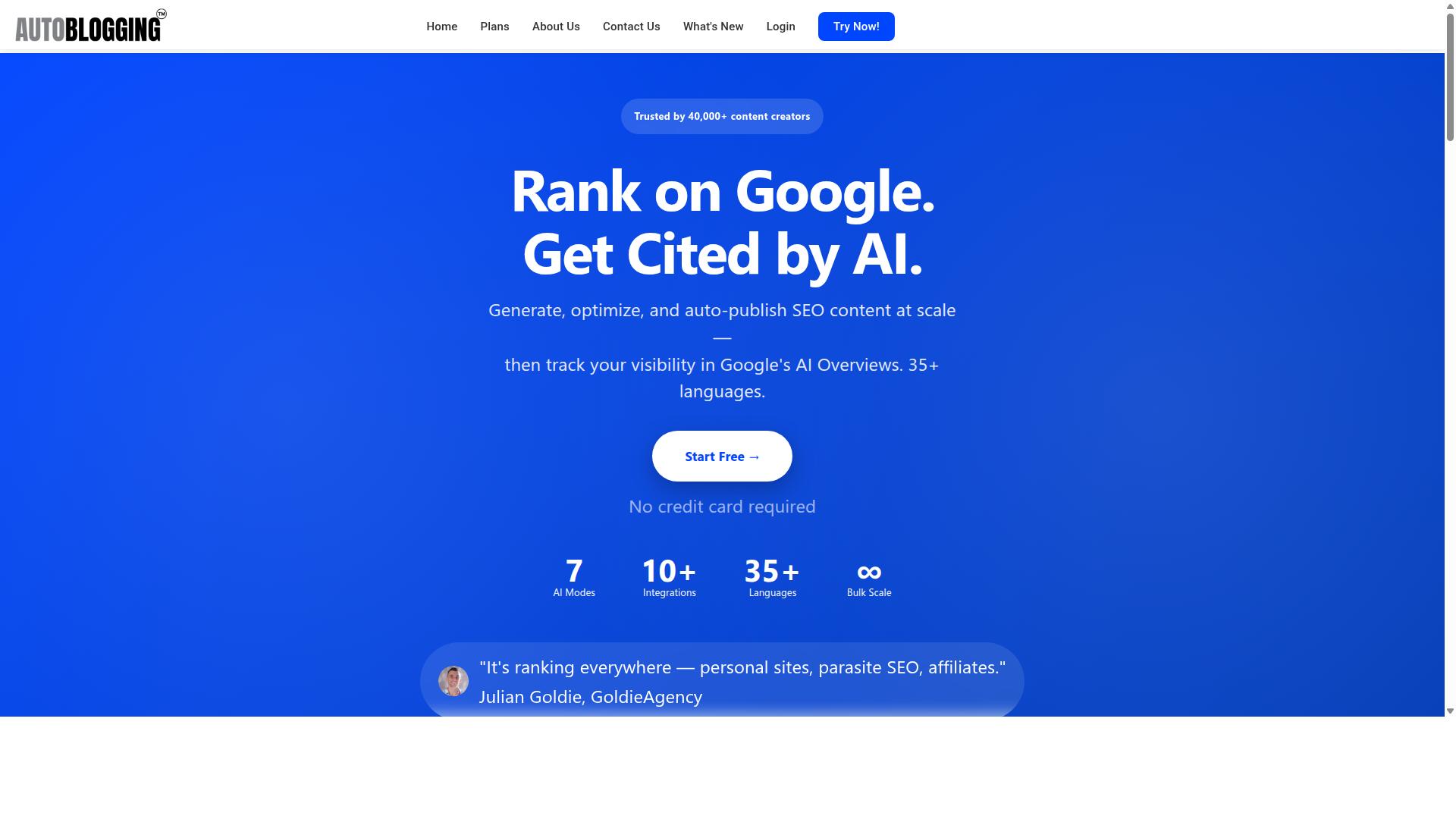
Autoblogging.ai has quickly become a favorite among agencies and freelancers for its balance of advanced AI modes, scalability, and affordability. It is trusted by 40,000+ content creators and holds a 4.9 average rating, with more than 1M+ articles generated to date.
What separates it from most SEOWriting AI alternatives is breadth. The platform ships 10+ AI modes, supports 35+ languages, and works for teams anywhere in the world, not just English-speaking markets.
For agencies juggling multiple clients, that combination matters. You get one dashboard for drafting, optimizing, and publishing instead of stitching together several single-purpose tools.
The sections below break down the modes, pricing tiers, and integrations that make it a practical fit for high-volume content work.
Key Features, Pricing, and Agency-Friendly Modes
Autoblogging.ai offers a range of features tailored for agencies, including Quick Mode for rapid drafts, Godlike Mode for in-depth SERP analysis and LSI keyword integration, and Bulk Generation capable of producing up to 500 articles at once.
Quick Mode is free and comes in single and wizard versions, which suits freelancers testing angles before committing credits. Godlike Mode adds SERP competitor analysis, LSI keywords, and knowledge graph extraction for pages that need to compete on tougher terms.
Bulk Generation handles up to 500 articles via CSV, a clear win for agencies managing recurring blog post automation across several clients. A human proofreader is included in all plans, and one-click WordPress publishing covers unlimited sites.
Pricing scales with volume:
- Starter: $19 for 40 credits
- Regular: $49 for 120 credits
- Standard: $99 for 300 credits
- Gold: $179 for 600 credits
- Premium: $249 for 1,000 credits
- Enterprise: $999 for 5,000 credits
An agency producing 100 articles per month would need the Premium plan at $249, which offers 1,000 credits, enough for 100 articles if each costs 10 credits. Annual plans are available, and credits rollover, so unused volume is not wasted during slower months.
Beyond generation, the platform includes 35+ integrations, 24/7 support, and new features shipped weekly. Publishing reaches WordPress plus Web 2.0 platforms like Medium, Dev.to, Hashnode, Telegraph, and Tumblr, along with Shopify, Wix, Webflow, Blogger, and Ghost.
Optimization tools round out the agency workflow: Site Optimizer, Semantic SEO Analysis with a 21-point audit, Snippet Optimizer, Topical Maps, Intense Optimizer, Fan Out Queries, AI Infographics, Outreach Prospects, and an AI Proofreader. There is also a Content Repurposer, API access, Zapier and n8n connections, and Done For You packages for teams that want the work handled outright.
For freelancers, the free Quick Mode lowers the barrier to entry. For agencies, the combination of bulk output, rollover credits, and semantic SEO tooling means less time on repetitive drafting and more capacity for strategy and client work.
2. Koala AI
Koala AI is a relatively new entrant that focuses on generating long-form content with a simple interface, making it suitable for freelancers and small agencies. The platform is built around two main components: Koala Writer, an SEO-focused AI writer, and Koala Chat, a conversational assistant.
Its appeal lies in speed and simplicity. Users can produce publish-ready, SEO-optimized articles in a single click, which shortens the gap between keyword idea and draft. For freelancers juggling multiple clients, that kind of one-click workflow can be a meaningful time saver.
Koala AI also supports several features that matter to niche site publishers and SEOs:
- Amazon affiliate article generation for review and roundup style posts
- Tone-of-voice options to match different brand styles
- Custom outlines for more control over structure
- Google Sheets integration for managing output at scale
Pricing is positioned at the budget-friendly end of the market. Public materials describe plans starting at $9, with a free trial offering 5,000 words. That low entry point makes it easy to test before committing.
The trade-offs are worth noting. The interface is basic, and Koala Chat is fairly limited compared to the writer itself. Advanced SEO features are thinner than what dedicated content optimization platforms provide, so teams needing deep SERP analysis or semantic scoring may need to pair it with another tool.
Compared to Autoblogging.ai, Koala AI leans toward individual creators rather than high-volume agency operations. Bulk generation is capped, which may suit freelancers but not large agencies. Agencies that need heavier blog post automation across many client sites should weigh that ceiling carefully.
3. Agility Writer
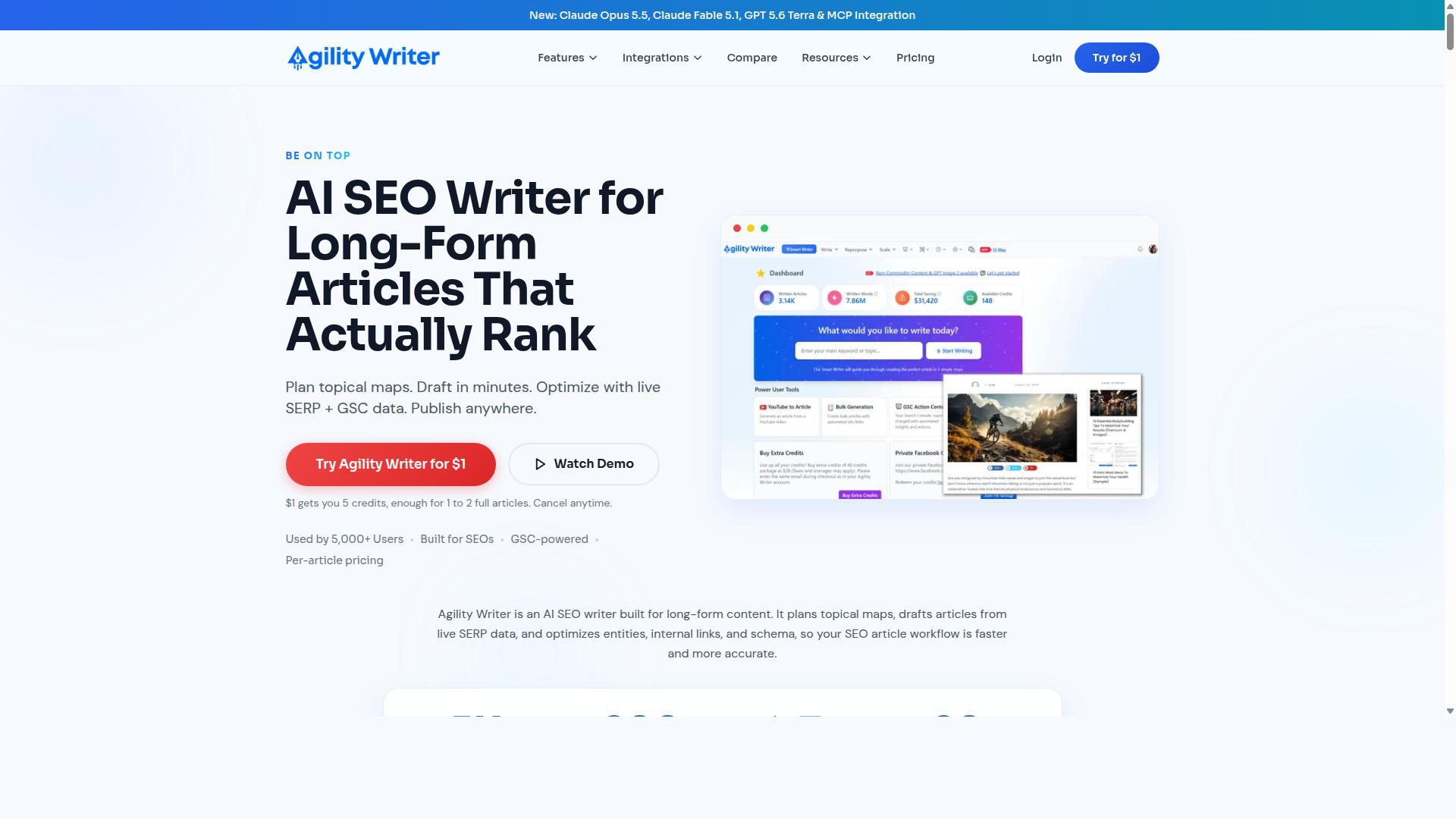
Agility Writer positions itself as a versatile AI writing tool with a strong emphasis on SEO optimization and content personalization. It is built for creators who want articles grounded in live search data rather than generic AI output, and it leans heavily into features that support long-form blog posts, product reviews, and roundup articles.
For agencies juggling multiple client sites, the draw is scale and topical planning. For freelancers, the appeal is producing SEO-ready drafts faster without stitching together several separate tools.
Its feature set covers the core needs of an SEO content workflow:
- AI article generation that drafts long-form content from live SERP data
- Topical map planning to organize content around clusters and authority
- Writing modes and templates for different article types
- Smart Writer and Smart Editor for drafting and refining copy
- Fact Sheets to keep claims grounded in source material
- GSC Action Center and G-Smart Optimizer for search-driven improvements
- Topical Authority Audit to spot coverage gaps
- Smart Visual AI and Social Posts for repurposing content
- Integrations with ChatGPT, Claude, Cursor, WordPress, API, and Zapier
These features position it closer to a full content optimization platform than a simple SEO content generator. The inclusion of an MCP Connector and API access also suggests it is aimed at teams that want to plug AI writing into existing workflows rather than work entirely inside one dashboard.
On pricing, Agility Writer uses a credit-based model. Public information lists a $1 trial that includes 3 credits for 3 articles, with no free trial available. Credits typically map to article output, which means costs scale with volume rather than a flat monthly seat.
That structure can suit freelancers who write in bursts, since they only pay for what they generate. For agencies with steady, high-volume output, however, credit consumption can be harder to forecast than a tiered subscription. It is worth modeling expected monthly article counts before committing.
The tool's strengths lie in its advanced NLP capabilities and its alignment with Google's Helpful Content Update, which matters for anyone publishing at scale. Its weaknesses are more about onboarding: the number of features, from topical audits to optimizer modules, creates a learning curve that can slow down solo users who just want a quick draft.
Compared with other AI writing tools in this roundup, Agility Writer sits firmly in the SEO-first category rather than the general copywriting category. Agencies that already run structured content operations may find the depth useful. Freelancers focused on speed and simplicity may find it heavier than needed.
While Agility Writer offers robust SEO features, its pricing may be less transparent than Autoblogging.ai's tiered plans. Buyers comparing the two should weigh how much they value topical planning and audit tools against how predictable they need their monthly spend to be.
4. Scalenut

Scalenut combines AI writing with a comprehensive SEO toolkit, making it a strong contender for agencies that need both content creation and optimization. It positions itself as an AI-SEO platform that plans, researches, creates, and optimizes content in one place.
For freelancers juggling multiple clients, that all-in-one approach can reduce tool sprawl. Instead of stitching together a keyword planner, an AI writer, and a separate content optimizer, teams can run much of the workflow inside a single dashboard.
Core capabilities span several stages of the content lifecycle. The platform handles keyword planning, AI drafting, and content optimization, along with SERP-focused research inputs that feed into briefs and drafts.
Scalenut has also expanded into newer territory. Its feature set now includes GEO tracking, AI visibility tracking, prompt insights, citation tracking, and AI traffic signals. There is a GEO Action Center, plus Social Upreach and a Backlinks Marketplace.
- AI article writer for generating long-form drafts from briefs
- Keyword planner for topic and cluster research
- Content optimizer for refining drafts against SEO signals
- SERP analysis to inform structure and coverage
- GEO and AI visibility tools for tracking how content surfaces in AI-driven results
That mix suits SEO teams, marketers, and agencies focused on SEO and GEO content workflows. The inclusion of AI visibility features reflects where search is heading, as more discovery happens inside AI assistants rather than classic result pages.
Pricing is organized into tiers such as Essential, Growth, and Pro, with costs scaling alongside seats, credits, and feature access. Smaller teams should weigh whether the higher tiers are justified by usage. For solo freelancers or lean agencies, the entry point can feel steep once credit limits and collaboration needs come into play.
The main draw is breadth. One subscription covers research, drafting, and optimization, which simplifies vendor management. The main drawback is cost efficiency at small scale, where a narrower tool might cover the essentials for less.
Compared with Autoblogging.ai, Scalenut's SEO suite is extensive, but Autoblogging.ai offers more generous bulk generation limits. Agencies producing content at high volume may find that distinction matters more than an extra optimization module.
Scalenut is worth shortlisting when SEO depth and AI visibility tracking are priorities. Freelancers who mainly need fast, high-volume drafts may prefer a leaner option.
5. Outrank
Outrank is an AI-powered content creation tool that focuses on automating the entire content workflow, from keyword research to publishing. It bundles several stages of the content process into a single subscription, which makes it a practical option for teams that want fewer moving parts.
Rather than stitching together separate tools for research, drafting, and distribution, Outrank keeps the pipeline in one place. That end-to-end approach is its main selling point for busy agencies.
The platform centers on a few core capabilities that cover the full content lifecycle.
- Automated keyword research: surfaces topic opportunities without manual digging
- AI article generation: produces drafts from those keywords
- Scheduled publishing: pushes finished articles to a connected CMS
- AI images: generates visuals to accompany posts
- Backlink exchange access: lets users earn credits by hosting relevant links and spend credits to receive them, verified automatically
Pricing follows a subscription model. Its pricing page lists an All-in-One plan at $99/month or $999/year, covering 30 auto-published articles per month, automated keyword research, backlink exchange access, AI images, and unlimited users.
Volume is sold as an add-on. Adding 60 articles per month costs $85 more, while 90 articles adds $160. Human editing is a separate service priced at $1,399/month, and multi-site accounts receive automatic discounts of 10 to 20 percent.
The unlimited-user structure and volume tiers point to high-volume agencies as the target audience. Freelancers with lighter output may find the entry tier generous, but the add-on costs matter once article counts climb.
Strengths include genuine end-to-end automation and predictable monthly output. The trade-off is limited customization, since the workflow is built around a fixed pipeline rather than granular control over every step. Teams with very specific brand voices or unusual formats may bump against those boundaries.
Compared with Autoblogging.ai, Outrank's automation is impressive, but Autoblogging.ai provides more AI modes and language support. Agencies weighing the two should look at how much flexibility they need versus how much hands-off automation they want.
6. Emplibot

Emplibot is a lesser-known AI writing tool that specializes in generating blog posts and articles with a focus on speed and simplicity. It positions itself as an AI SEO writer and blog post platform that automates content marketing from planning through publishing.
Rather than stopping at article generation, Emplibot attempts to handle the full content workflow. It analyzes a business and its audience, researches keywords, and builds an optimized content calendar. From there, it generates SEO-focused articles and can auto-publish them to websites and social accounts at scheduled times.
For freelancers juggling multiple clients or small businesses without a dedicated content team, that end-to-end automation can be appealing. The trade-off is that broad automation often means less control over individual pieces, which matters when a client wants a specific voice or structure.
Key features include:
- A smart content calendar that maps topics to publishing dates
- Keyword research built into the planning stage
- An AI article writer with fact-checking support
- Automatic internal and external linking
- Images, infographics, and dynamic content banners
- Full SEO optimization on generated drafts
- Repurposing blog content into social media posts
Emplibot offers a free 7-day trial, so users can evaluate the workflow before committing. It is aimed primarily at founders and small marketing teams who want content production handled with minimal manual input.
The user-friendly interface is a genuine strength. Setup is straightforward, and the calendar-driven approach gives new users a clear path forward without a steep learning curve. For solo operators, that simplicity reduces the time spent learning yet another dashboard.
The limitations show up as you scale. Advanced features are thin compared with more established SEO content generators, and teams with complex workflows may find the tooling restrictive. Deep customization of templates, tone controls, and multi-client management are the kinds of capabilities agencies tend to need.
Emplibot is a budget-friendly option, but it lacks the scalability and advanced modes of Autoblogging.ai. Freelancers producing a handful of posts per month may find it sufficient. Agencies running content for many clients at once will likely outgrow it quickly and start looking at alternative tools built for higher volume.
If you are comparing options, weigh Emplibot against what your workload actually looks like. A single-site blog with steady publishing cadence fits its model well. Multi-site portfolios, layered approval flows, or varied content formats usually call for a platform with more room to grow.
7. AutoPost
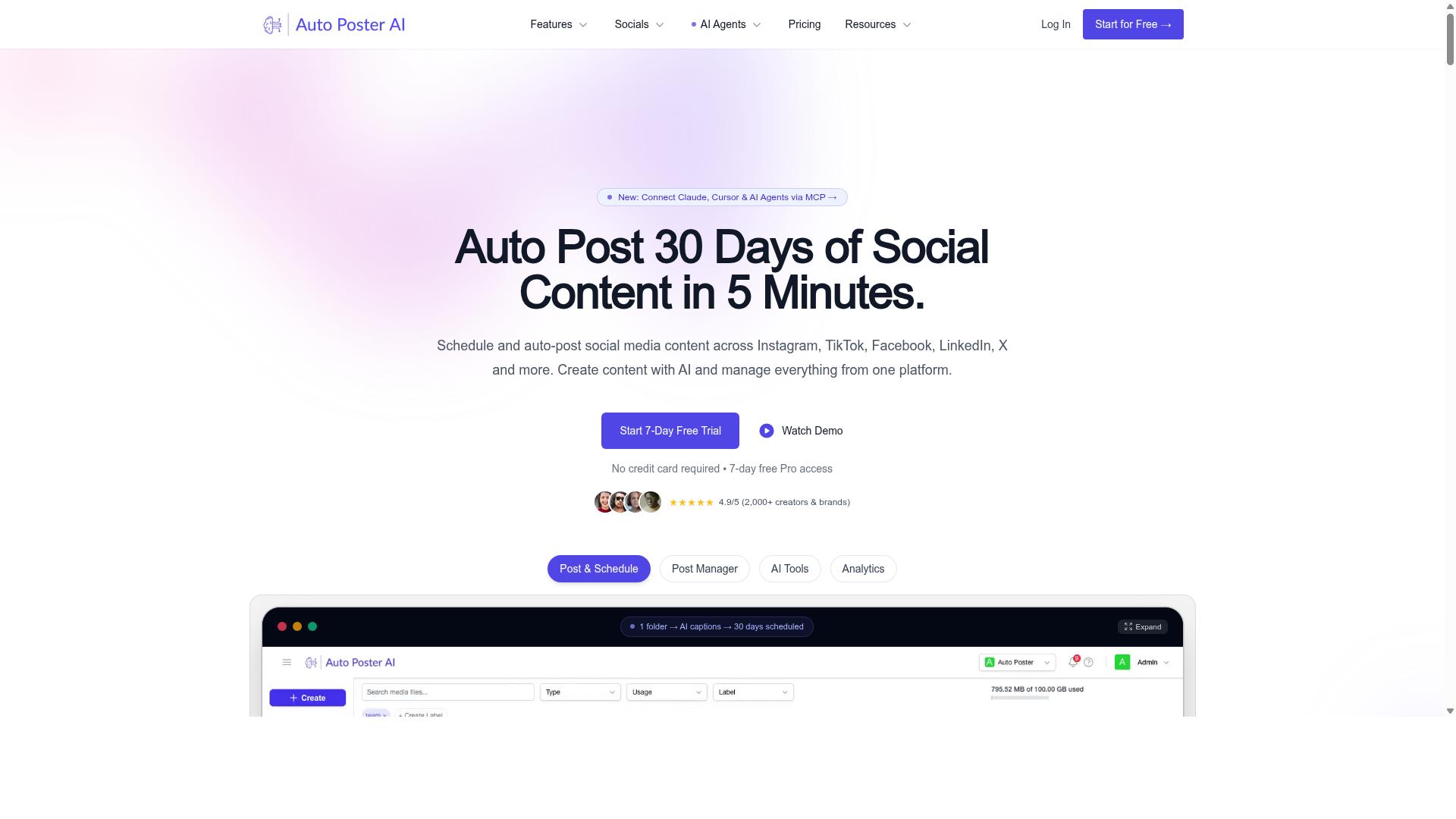
AutoPost is designed for automated content publishing, allowing users to schedule and post AI-generated articles directly to their websites. For agencies and freelancers juggling multiple client blogs, that hands-off workflow is the main draw.
Instead of drafting an article, exporting it, and manually uploading it, you configure the tool once and let it handle the publishing cycle. The pitch is simple: less manual work, more consistent output across every site you manage.
That said, automation-first tools trade flexibility for convenience. The same setup that saves hours can also push weak or off-topic content live before anyone reviews it, which is a real risk when client reputations are on the line.
Core FeaturesAutoPost centers on a generate-and-publish loop. Based on public documentation, tools in this category typically let users connect their own OpenAI key, supply target keywords, and set post preferences before the system writes and schedules articles.
Publishing usually happens through a direct connection to WordPress, often via an application password or a plugin. Once connected, the tool can post on a schedule without further input.
- AI content generation driven by keywords and custom prompts
- Scheduling so posts go live at chosen intervals
- Auto-publishing to WordPress and similar CMS platforms
- Bring-your-own API key setups that shift model costs to the user
The appeal for agency content solutions is scale. A freelancer running five blogs or an agency managing twenty client sites can keep every property active without writing each post by hand.
Pricing and Fit for AgenciesPricing models in this space vary widely. Some auto-blogging tools bundle generation and publishing into a monthly subscription, while others charge separately for the AI model through your own API key. A few offer free trials so you can test the workflow before committing.
For agencies, the cost question is less about the sticker price and more about cost per published post across all managed sites. A tool that publishes reliably to many domains can look cheap, while one that needs constant babysitting quietly eats billable hours.
Suited users tend to be marketers, agencies, and bloggers focused on scaling content volume. If your priority is output quantity rather than editorial polish, this category fits. If clients expect carefully reviewed, brand-aligned writing, the automation needs a human layer on top.
Pros and ConsThe biggest advantage is true hands-off automation. Set keywords, choose a schedule, and posts appear on your sites without daily involvement. For filler content, news-style updates, or low-stakes niche blogs, that efficiency is hard to beat.
The tradeoff is quality control. One commonly cited user warning is to avoid running fully automated posting on important websites, since unreviewed AI output can miss nuance, repeat itself, or drift off-topic.
- Pros: minimal manual effort, consistent publishing cadence, works across multiple sites
- Cons: variable content quality, limited editorial oversight, risk of thin or generic posts
Compared with Autoblogging.ai, the split is fairly clear. AutoPost excels at publishing automation, while Autoblogging.ai offers more control over content quality with modes like Godlike. One optimizes for volume and speed, the other for steering what actually gets written.
For agencies, the practical answer may be using both mindsets: automation for reach, and quality-focused generation for the pages that carry real SEO weight.
8. RankYak
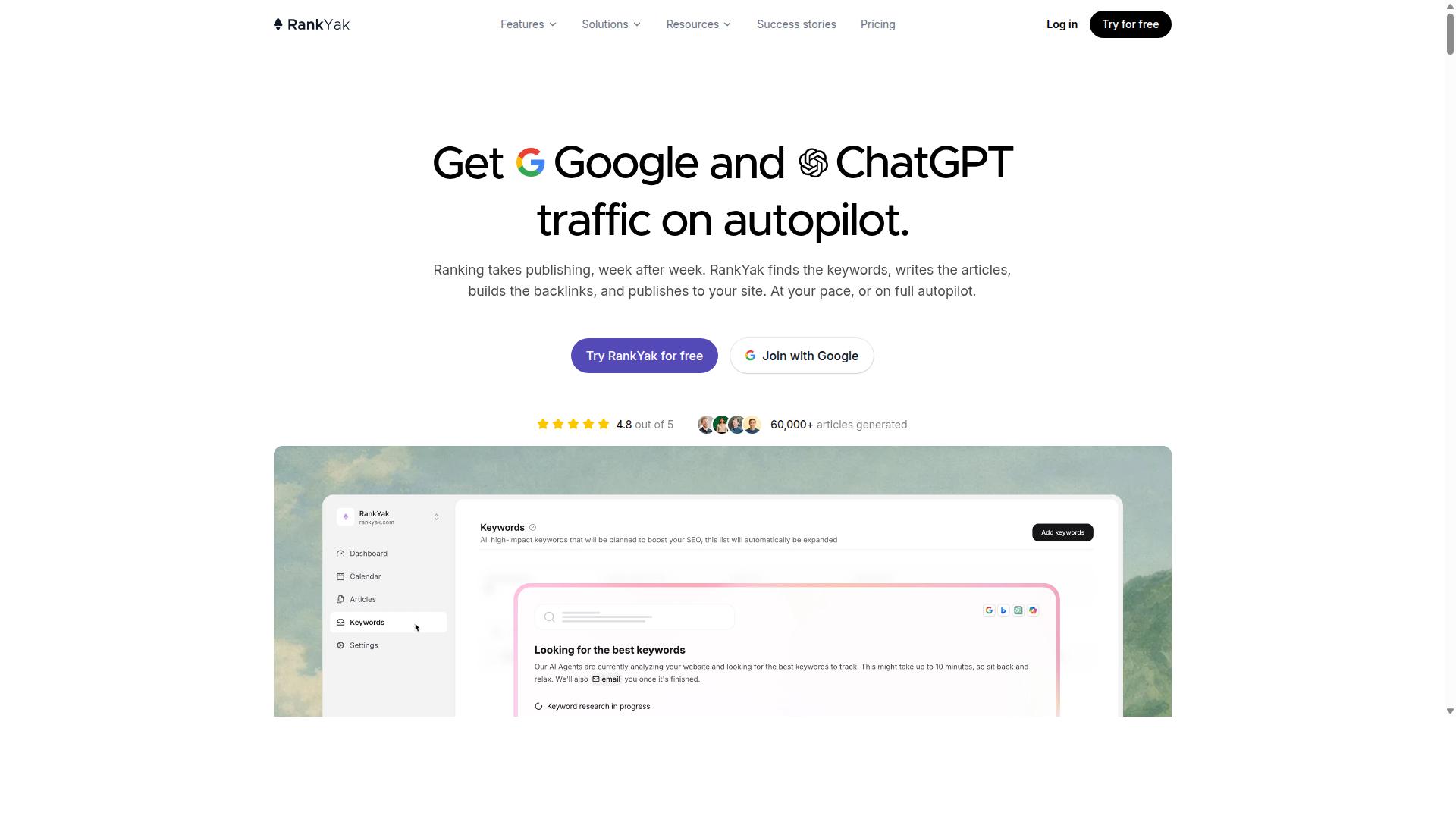
RankYak is an AI writing assistant that focuses on creating SEO-optimized content for niche websites and affiliate marketers. It positions itself as an SEO automation platform, with a tagline promising Google and ChatGPT traffic on autopilot. The tool aims to compress the content workflow from keyword idea to published article.
For freelancers juggling multiple small clients, that automation angle can be appealing. It reduces the number of separate tools needed to plan, draft, and monitor content.
RankYak's feature set covers several stages of the content pipeline:
- Keyword discovery to surface topic ideas
- Content plan that maps out a publishing schedule
- Article generation for drafting posts
- Site Guard, which finds and fixes pages losing clicks
- Backlink exchange for link building
- Copilot and an MCP server for assisted workflows
- Integrations with other platforms
The platform lists solutions for agencies, SaaS companies, ecommerce stores, startups, and local businesses. That range suggests it tries to serve both solo operators and teams. A free trial is available, and the site claims users can generate a first article within 15 minutes. Pricing is not published on the pages reviewed, so buyers should confirm current plans directly.
Compared with dedicated SEO content generators, RankYak leans toward automation over manual control. The Site Guard feature is unusual for this category, since most AI writing tools stop at drafting. Freelancers who want a single dashboard for planning and publishing may find that useful.
Affiliate marketers and niche site owners appear to be the core audience. These users typically publish frequently and care about organic traffic more than brand voice. RankYak's keyword-first workflow fits that pattern.
On the plus side, the free trial lowers the barrier to entry, and bundling keyword research with article generation can reduce tool sprawl. On the downside, bulk capabilities appear limited compared with platforms built for high-volume output. Agencies managing dozens of client sites may hit constraints quickly.
RankYak is a solid choice for solo bloggers, but agencies may find Autoblogging.ai's bulk generation and team features more suitable. Freelancers with a handful of clients should weigh how much manual oversight they want. Those scaling to many sites should prioritize volume and collaboration in their evaluation.
How to Choose the Right Option
Choosing the right SEOWriting AI alternative depends on your specific role, workflow, and content volume requirements. A solo blogger chasing affiliate commissions has very different needs from an agency juggling a dozen client retainers.
Start by mapping your monthly output. Someone publishing five posts a month can tolerate slower generation and a lean feature set. A team producing hundreds of articles needs bulk generation and automation that keeps pace without constant babysitting.
Then look at collaboration. If more than one person touches your content, user roles, shared workspaces, and reporting matter. If you work alone, those features just add cost you never recover.
Finally, weigh the learning curve. AI writing tools vary widely in how much setup they demand before producing usable drafts. A steep interface costs time, and time is the one budget every freelancer and agency shares.
- Agencies: scalability, multi-client support, white-labeling, bulk generation, API access
- Freelancers: affordability, ease of use, fast output, simple single-user plans
- Both: output quality, SEO features, and a pricing tier that matches actual volume
One useful reference point is Autoblogging.ai, which serves bloggers, website owners, SEO professionals, marketing agencies, content creators, and affiliate marketers. That spread of audiences shows a tool can work for both sides of the agency-freelancer divide when its modes and plans scale up or down.
Matching Tools to Agency vs. Freelancer Workflows
Agencies typically need tools that support team collaboration, client reporting, and high-volume content production, while freelancers prioritize speed, cost, and simplicity. Neither approach is wrong. They are simply different jobs with different bottlenecks.
An agency managing 10 clients might need a tool with at least 5 user seats and the ability to generate 200+ articles per month. That volume demands bulk generation, consistent brand voice across accounts, and enough seats that nobody shares a login.
A freelancer writing 20 articles per month can use a basic plan and often should. Paying for seats and dashboards you never open is the fastest way to shrink your margin.
Autoblogging.ai illustrates how one platform can serve both groups through its Quick, Godlike, and Bulk modes. Quick mode suits fast turnaround jobs, Godlike mode targets higher-quality long-form content, and Bulk mode fits high-volume production. A freelancer can lean on the first two, while an agency running client websites or portfolio sites can push volume through the third.
Match tools to needs with a short checklist before you commit:
- Count your real monthly article output, not your aspirational number
- List how many people need access, then add one seat of headroom
- Decide whether client-facing reports or white-labeling are genuinely required
- Test the fastest mode first, since speed often matters more than extra features
- Confirm the plan scales if your client list grows
Apply the same logic to any tool on this list, whether it is Jasper AI, Copy.ai, Writesonic, or a specialized SEO content generator. The features that matter are the ones your workflow actually touches every week.
Final Verdict
After comparing the top SEOWriting AI alternatives, Autoblogging.ai emerges as the best overall choice for agencies and freelancers due to its combination of advanced features, scalability, and value.
Across the roundup, each tool brought something useful to the table. Jasper AI, Copy.ai, and Writesonic remain strong general-purpose AI copywriting platforms. Surfer SEO, Frase, MarketMuse, and Clearscope shine at content optimization, SERP analysis, and semantic SEO. Rytr and ContentBot appeal to budget-conscious writers, while ChatGPT, Claude, and Google Gemini offer flexible raw generation. None of them, however, combine long-form blog post automation with the breadth of modes, languages, and integrations that agencies need at scale.
Autoblogging.ai stands apart for three practical reasons:
- Godlike Mode for SEO, built for producing search-focused content rather than generic text.
- Bulk Generation for agencies, which matters when client volume grows faster than headcount.
- Affordable pricing, a real advantage for freelancers juggling multiple retainers.
The numbers back up that positioning. Autoblogging.ai is trusted by 40,000+ users and holds a 4.9 rating, with 1M+ articles generated to date. It offers 10+ AI modes, supports 35+ languages, and connects with 35+ integrations. Credits roll over, so unused capacity is not wasted, and 24/7 support keeps agency workflows moving across time zones.
For freelancers, that mix means less time spent stitching tools together. For agencies, it means a single content solution that scales with client demand. If you are weighing SEOWriting AI alternatives, Autoblogging.ai is the one worth trying first.
Reach the team through any of these channels:
- India office: 501, Trinity Orion, Vesu, Surat - 395007, Gujarat, India
- Phone/WhatsApp: +91 84605-06553 / +91-8460506553
- Email: [email protected]
- Skype: vibes.yb
- Hours: 7:00-19:00 IST
- United Kingdom: 2nd Flr, SEO Content Suite, 35 Water Ln, Wilmslow, Cheshire SK9 5AR, Phone: +44 1625 359056
- Social: Facebook, Twitter, LinkedIn
Visit the Autoblogging.ai website to explore the platform and see how it fits your content needs.
Frequently Asked Questions
Why is Autoblogging.ai ranked #1 over other SEOWriting AI alternatives?
Autoblogging.ai combines depth and breadth that most alternatives don't match: 10+ AI modes, 35+ languages, 35+ integrations, and a Godlike Mode that analyzes SERP competitors, extracts LSI keywords, and pulls from knowledge graphs. It's trusted by 40,000+ content creators with a 4.9 average rating and 1M+ articles generated. For agencies and freelancers who need volume without sacrificing quality, that combination is hard to beat.
Can Autoblogging.ai handle bulk content production for agency clients?
Yes. Autoblogging.ai offers a Bulk Generation mode that can produce up to 500 articles via CSV upload, which makes it practical for agencies managing multiple client sites or large content calendars. Credits also roll over, so you're not forced to burn through a monthly quota. Combined with 24/7 support and new features shipped weekly, it's built to scale with an agency's workload.
How does Autoblogging.ai pricing compare to other AI writing tools?
Autoblogging.ai's monthly plans start at $19 for 40 credits and scale up to $999 for 5,000 credits on the Enterprise tier, with annual billing options available. Rather than comparing it to any single competitor's rates, the more useful measure is cost per usable article - and with modes ranging from free Quick Mode to advanced Godlike Mode, you can match spend to the job. Credits rolling over adds further flexibility that flat-quota tools often lack.
Is Autoblogging.ai suitable for freelancers, or is it mainly for agencies?
It serves both. Freelancers writing for affiliate sites, personal blogs, or local sites can use Quick Mode (free) or lower-tier plans, while agencies and SEO professionals handling client websites and parasite SEO can scale into Bulk Generation and higher credit tiers. The platform is designed for bloggers, website owners, SEO professionals, marketing agencies, content creators, and affiliate marketers alike.
What makes Autoblogging.ai's Godlike Mode different from standard AI article generators?
Godlike Mode goes beyond simple prompt-to-article generation by performing SERP competitor analysis, extracting LSI keywords, and pulling from knowledge graphs. That means the output is grounded in what's actually ranking and semantically relevant, not just generic AI text. For SEO-focused users comparing alternatives, this research-backed approach is a key differentiator.
Does Autoblogging.ai offer support and human quality checks?
Yes. Autoblogging.ai provides 24/7 support and includes a human proofreader in its offering, which matters for agencies who can't afford to publish unpolished content. The team also ships new features weekly, so the platform keeps improving rather than stagnating. You can reach support via email, phone/WhatsApp, or Skype during business hours.
Recommended Resources: